
Non-Profit Initiatives
Our commitment to the region
As a regional company, from our very beginnings we have sought different ways to contribute — economically, culturally and socially — to our beautiful Aysén region. That's why below we share initiatives we have organized, as well as others we have taken part in together with our community.
Beach Clean-ups with children and parents from the Gabriela Mistral school in Puerto Río Tranquilo
We believe that biodiversity conservation grows stronger when people can observe and experience close contact with nature. That's why, since 2022, we have been organizing gatherings with families from Puerto Río Tranquilo, Bahía Murta and Coyhaique, where we camp at Laguna San Rafael and run beach clean-up days, particularly removing microplastics and other debris from the coast between Bahía Exploradores and Laguna San Rafael. During these gatherings we also run workshops on wildlife and outdoor life. On some occasions we have had the support of AG Hielo Norte and funding from the Ministry of the Environment, as well as from the NGO Parley in central Chile. Beyond a great number of volunteers willing to help in all sorts of ways, several local businesses have joined this initiative: Rumbo Nativo, Ecoturismo Exploradores, Parque Exploradores, Nimbus, Scouting Ríos and Nomade Experience.
SEI Viajera de los Mares Project: a whale for the Puerto Río Tranquilo school
In 2015, during a family expedition to the Istmo de Ofqui, a crazy idea began to take shape and eventually became a whale skeleton installed in front of the Gabriela Mistral school in Puerto Río Tranquilo. This project, developed together with the Aysén Mira el Mar foundation, AG Hielo Norte, Parque Exploradores, the Municipality of Río Ibáñez, Centro COPAS, the Regional Museum and the Puerto Tranquilo Museum, involved moving the remains of a Sei whale from Seno Escondido, inside Laguna San Rafael National Park, to Puerto Río Tranquilo, in order to create new connections between the community, visitors and the sea. The remains belong to a juvenile Sei whale that was part of one of the largest strandings of this species ever recorded, in 2015. The whale, named INARA by the school's children, is permanently on display in front of the school.
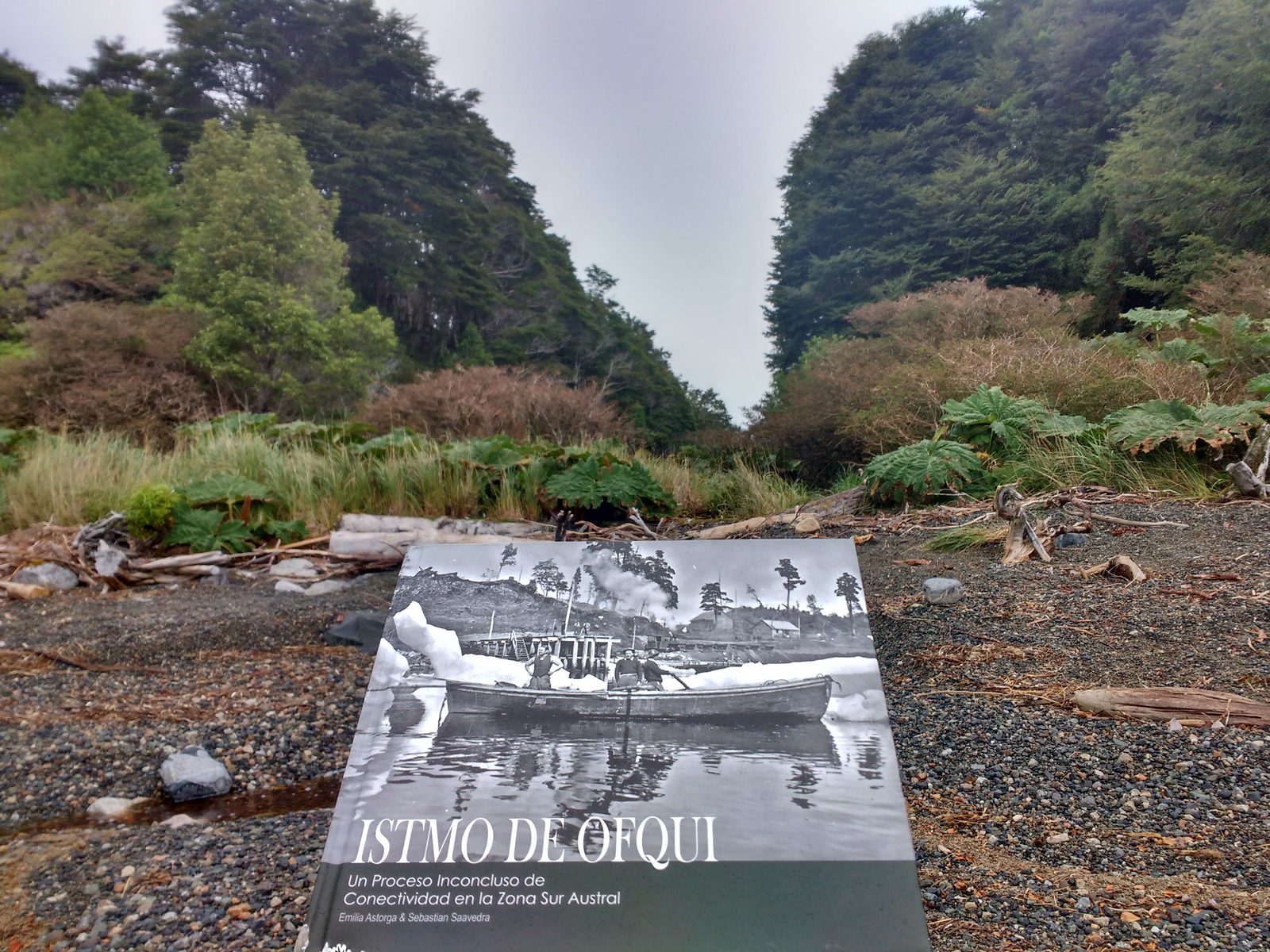
See the full project →Book “Istmo de Ofqui: un proceso inconcluso de conectividad en la zona sur austral” (an unfinished process of connectivity in the southern austral zone)
FONDART Project 2014–2016. We sometimes assume that territories as remote as Laguna San Rafael were never touched by human hands, yet we know that indigenous communities and settlers traveled through these landscapes for centuries. In 2014, driven by a wish to learn more about this history, we carried out a research project on the construction of a canal in the Istmo de Ofqui area and a tourism hotel at Laguna San Rafael — a project of the State Railway Company (Empresa de Ferrocarriles del Estado) conceived in the early 20th century and begun in 1937, when construction of the canal started. The goal was to create an inland shipping route that would connect the Magallanes region with Puerto Montt more safely. The canal would have opened new opportunities for development and settlement in the young Aysén region, but given the harsh conditions of the area and the lack of funding and machinery, the works were abandoned in 1943. All that remains are the traces of what was once a community of at least three hundred people, one of whom — its last survivor, 90-year-old Mrs. Ángela Pérez — we were fortunate enough to interview. Book published by the Ñire Negro publishing house in Coyhaique.

Contribution to publications and scientific research
By traveling through remote areas that few people have access to, we have been able to observe and share places, events, species and archaeological remains that had not previously been recorded at this latitude. This is why we are recognized as collaborators in scientific publications and projects aimed at producing information and sharing it with the regional, national and international community.
Publications
- Sade, K., Westfall, C., Pérez-Barría, L. & Torres, D. (2022). Archaeological records, crossings and natural barriers surrounding the North Ice Fields (Aysén, Chile). Revista de Aysenología, 11, 33–49. Coyhaique. View the article ↗
Video
El misterio de las ballenas · Centro Científico CEAZA · Watch on YouTube